FDA, CTTI Convening 2025 Hybrid Public Workshop on Artificial Intelligence in Drug & Biological Product Development

CTTI News | August 25, 2025

Topics Included: Artificial Intelligence

Registration is now open for the second Hybrid Public Workshop on Artificial Intelligence in Drug and Biological Product Development, hosted by the U.S. Food and Drug Administration in collaboration with the Clinical Trials Transformation Initiative. The event will take place on October 7, 2025, in person at The National Press Club in Washington, DC, and online via Zoom.

Join experts from across sectors for a forward-looking discussion on how artificial intelligence (AI) is transforming drug and biological product development. Building on momentum from the first workshop in 2024, this year’s event will highlight real-world breakthroughs and explore how AI is advancing the safety, efficacy, and quality of drugs and biological products.

Speakers will address best practices, cross-disciplinary collaboration, and practical strategies to improve data quality, reduce bias, and increase transparency in AI models. Attendees will gain insights into responsible applications of AI in clinical research and to support regulatory decisions, along with opportunities to support innovation across the field.

The workshop will run from 9:00 a.m. to 5:00 p.m. Eastern Daylight Time. Attendance is free and open to the public.

Register now to be part of this important conversation on the future of AI in medical product development.

CTTI Releases New Recommendations to Guide Use of Disease Progression Modeling in Medical Product Development

CTTI News | July 8, 2025

Topics Included: Innovative Trials, Regulatory Submissions + Approvals

CTTI today released new recommendations to support the effective use of disease progression modeling (DPM) in medical product development. The goal is to enable smarter, more efficient, and more evidence-based decisions by identifying when DPM should be considered and what is needed to implement it successfully. 

A disease progression model is a mathematical model that quantitatively describes the time course or trajectory of a disease. When used appropriately, DPM can integrate diverse sources of data—including translational, clinical, and real-world data—to improve trial design, reduce uncertainty, and tailor development strategies toward more personalized, targeted approaches. It can also help address knowledge gaps, support regulatory engagement, and strengthen the totality of evidence on a product’s benefit-risk profile. 

“DPM has tremendous potential to enhance decision making across the development lifecycle, particularly when having knowledge of the disease course is critical,” said Lindsay Kehoe, CTTI Senior Project Manager. “These recommendations are designed to help cross-functional leaders ask the right questions, appreciate the unique value of DPM, and apply it in ways that lead to better outcomes for patients.” 

Many decision makers in medical product development face uncertainty around when and how to apply DPM, and how to weigh its benefits alongside other modeling approaches. CTTI’s recommendations offer practical guidance to address these challenges and support more strategic, efficient decision making across clinical, regulatory, and translational functions. 

The recommendations were developed by experts from across the clinical trials ecosystem and further refined by a multi-stakeholder recommendations advisory group. 

More information on the Disease Progression Modeling project is available on CTTI’s website.

Optimizing Flexibility and Data Quality in Clinical Trials: Bringing Clarity to DIA Global 2025 

CTTI News | June 25, 2025

Topics Included:

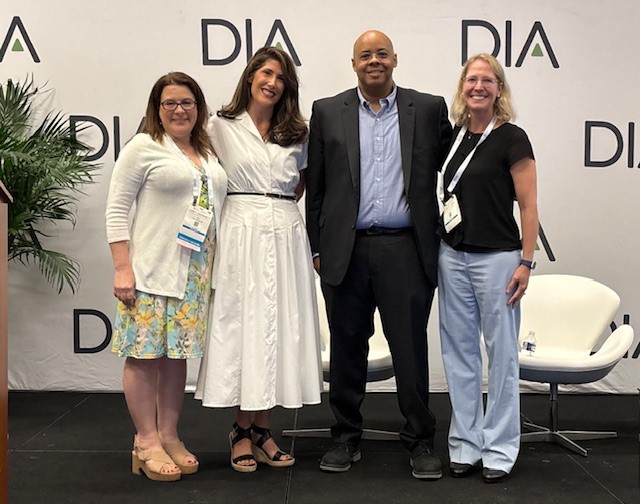
At this year’s DIA Global Annual Meeting, Lindsay Kehoe, senior project manager at the Clinical Trials Transformation Initiative, chaired a panel under Track 8 – R&D Quality and Compliance – titled, “Do Flexible Trial Approaches Impede Data Quality? Perception vs. Reality.” 

The panel brought together regulatory, data, and technology experts to explore how clinical trials can be modernized without compromising scientific rigor. Featured speakers included Cheryl Grandinetti of the Food and Drug Administration, Catherine Gregor of Florence Healthcare, and Ken Wiley of the National Institutes of Health. All three are collaborators on CTTI’s new initiative, “Optimizing Data Quality and Flexibility in Clinical Trials.” 

Together, the panelists examined how operational flexibility — such as integrating trials into clinical care, decentralizing data collection, and offering participant choice — can coexist with, and even enhance, data quality when guided by a Quality by Design (QbD) framework. 

Flexibility and data quality are not at odds. Instead, the discussion emphasized that both must be fit for purpose. Flexible approaches are evolving with increasing use, fostering faster recruitment, reduced participant burden, and greater inclusivity. However, to ensure that data remains credible and reliable, and provides evidence of effectiveness and safety for regulatory decision-making, those involved in designing and conducting trials must proactively identify critical-to-quality (CTQ) factors, map data flows, and mitigate risks through thoughtful design and oversight. 

CTTI’s project aims to bring clarity to this intersection by developing tools such as a process document, a map of data “pain points,” and case examples of successful flexible trials. These resources are intended to help sponsors, sites, and regulators align on acceptable data variability and completeness, define tolerable error thresholds, and ensure that trial designs are both patient-centric and scientifically sound. 

Looking ahead, the clinical research community must design studies that meet participant needs for easier involvement, are operationally feasible, and are of sound quality. The key takeaway is that flexibility and data quality are not opposing forces — they are complementary pillars of a modern, inclusive, and efficient clinical trial ecosystem. 

Those leading and supporting clinical trials are encouraged to engage early, plan intentionally, and design with purpose. 

New CTTI Project Aims to Develop Framework for Assessing U.S. Clinical Trial Site Capacity and Readiness for Public Health Emergencies

CTTI News | June 17, 2025

Topics Included: Clinical Trials Landscape

In recent years, concerns have been raised about the limited real-time awareness of U.S. clinical trial sites’ capacity and capabilities, including their ability to support a coordinated and effective response to public health emergencies (PHEs).

To address these gaps, CTTI has launched Project Watchtower, an initiative aimed at developing scalable strategies to evaluate and strengthen clinical trial site infrastructure and readiness across the United States.  

Through Watchtower, CTTI will define site capability and capacity benchmarks, assess the feasibility of a standardized site readiness evaluation, and identify methods to unlock additional research capacity. This includes addressing regulatory burdens, streamlining startup processes, and ensuring equitable patient recruitment, particularly in time-sensitive situations.  

To inform this work, CTTI will review past infrastructure mapping projects, engage experts through interviews and surveys, and convene expert meetings to share insights and shape recommendations. A modified Delphi process will also be used to reach consensus on framework content. 

The anticipated outputs of the project include a peer-reviewed manuscript outlining a standardized framework for assessing site capacity, capabilities and changes over time, as well as an estimate of existing U.S. clinical trial site capacity for inpatient, intensive care research on respiratory emerging infectious diseases. In addition, the project will include recommendations for establishing an ongoing U.S. clinical trial site inventory to support future coordinated responses. 

Through these efforts, Watchtower supports CTTI’s Transforming Trials 2030 vision by advancing a more agile, coordinated and equitable clinical trial enterprise that is equipped to meet urgent national health needs.

CTTI to Launch New Recommendations on Disease Progression Modeling in Free Public Webinar 

CTTI News | June 10, 2025

Topics Included: Innovative Trials

The Clinical Trials Transformation Initiative (CTTI) will host a free public webinar on Tuesday, July 8, to introduce new recommendations for using disease progression modeling (DPM) to improve medical product development. 

The webinar will include a welcome from Sara Calvert, CTTI director of projects; a keynote presentation from Cynthia J. (CJ) Musante, vice president of scientific research at Pfizer; a project overview from Lindsay Kehoe, CTTI senior project manager; and a panel discussion moderated by Kehoe featuring perspectives on the potential real-world application and impact of the recommendations. Panelists include Karthik Venkatakrishnan from EMD Serono, Tiffany Westrich-Robertson from AiArthritis, Theo Zanos from Northwell Health, and Efthymios Manolis from the European Medicines Agency. 

A disease progression model is a mathematical model that quantitatively describes the time course or trajectory of a disease. By integrating multi-disciplinary knowledge and data from different sources—including translational, clinical trial, and real-world data—DPM can improve trial design, answer questions of uncertainty, and support regulatory decisions. 

CTTI’s new recommendations aim to guide medical product development decision makers—such as clinical, regulatory, and innovation leaders—in identifying when DPM can offer unique value, what foundational elements are required, and how to communicate effectively with modeling experts to support its implementation. 

The 60-minute webinar will begin at 12:00 PM EDT. To attend, please take a moment to register 

We encourage you to share this announcement with colleagues or others in your network who may be interested in attending.

Inside the State of Clinical Trials: Perspectives, Problems, and Pathways Forward 

CTTI News | June 9, 2025

Topics Included:

The Clinical Trials Transformation Initiative (CTTI) convened 150 clinical trials leaders, patients, policy influencers, and trialists in Washington, D.C., on May 22 for a dynamic meeting focused on the state of clinical trials. The agenda centered on problem solving—identifying core tensions preventing transformative change across the enterprise and workshopping actionable solutions.  

Dynamic presenters set the stage for the day with reflections on “where are we now?” in clinical trials ahead of targeted workshops. Speakers included former FDA commissioner Dr. Rob Califf, Donna Cryer from the Global Liver Institute, Ken Getz from the Tufts Center on the Study of Drug Development, Brad Hirsch of Highlander Health, Esther Krofah from The Milken Institute, and Ramita Tandon from Walgreens.   

Attendees discussed the five areas of CTTI’s Transforming Trials 2030 vision in depth in breakout sessions that were deftly facilitated by over 25 leaders in the enterprise.  

“CTTI expertly designed the workshops to make sure there were multiple perspectives represented throughout the day,” said attendee Jane Myles, Program Director at the Decentralized Trials and Research Alliance (DTRA). “Our discussions tackled tough topics which really challenged our critical thinking for change in clinical trials.” 

Workshops focused on targeting the most problems in patient centricity, trials in routine settings, quality and efficiency, data availability, and population health. In a workshop discussing privacy and responsible re-use of data, attendees identified data ownership as a critical roadblock. Attendees emerged from workshops eager to implement a federated learning network to solve this problem that includes artificial intelligence (AI) to improve the ease and speed of data sharing.  

“One of our goals for this meeting was to have all attendees really see themselves in the solutions we’re cocreating,” said CTTI Executive Director Morgan Hanger. “Together, we represent the trials enterprise so it’s incumbent upon all of us to drive change within our own corners of the clinical trials ecosystem.”  

CTTI plans to release a detailed summary of the meeting in late June to help engage more people from across the clinical trials enterprise on actionable next steps for this transformation. 

Measuring Trials Transformation (MTT) Project Update: Tracking Progress Toward Transforming Clinical Trials

CTTI News | March 20, 2025

Topics Included: Clinical Trials Landscape

In September 2023, CTTI launched the Measuring Trials Transformation (MTT) Project to track progress toward CTTI’s Transforming Trials 2030 (TT2030) vision. Introduced in 2021, this vision outlines how clinical trials should evolve by 2030 to become more efficient and inclusive, focusing on five key pillars: patient-centeredness, integration with health processes, trials designed with a quality approach, data-driven approaches, and improving population health. To measure progress toward these goals, the MTT project created the Metrics Framework, a parsimonious set of metrics that correspond to key domains of progress within each of the TT2030 pillars. This framework is designed to assess the transformation of clinical trials by creating specific benchmarks for understanding the state of clinical trials both today and in the future.  

Since its launch, CTTI’s Measuring Trials Transformation team has made significant progress in refining the Metrics Framework by reviewing more than 100 public comments and incorporating feedback to improve the set of metrics. From the broader Framework, the team identified nine high-priority metrics to focus on for data collection and analysis. The team is currently analyzing original trial documentation from CTTI’s AACT database of Phase 3 interventional trials conducted at U.S. sites between 2018 and 2024 to be able to answer key metrics.

Kelly Avery, MTT Project Team Leader and Operations Administrator for Research at Mayo Clinic, said, “The MTT project at CTTI is focused on moving us into the future. We’re striving to truly understand the ‘state of clinical trials, and to do that, we must first establish a baseline. By creating this baseline, we’ll gain the clarity needed to guide our next steps and drive meaningful progress.”

To support the successful execution of the project, CTTI has partnered with ClinConnect, a patient advocacy platform with valuable expertise in clinical trial analysis. ClinConnect developed best-in-class technology to manage and promote a searchable database for patients and caregivers, making it simple and straightforward for everyone to understand the totality of their clinical trial options.   

Robert Maxwell, Founder of ClinConnect, highlighted the value of the collaboration, saying, “Working with the MTT team has been a highly rewarding experience. We’re aligned on the key challenges and moved by the progress we’ve made. The ClinConnect team thrives when we’re given the freedom and trust to address these issues head-on, and the MTT team has been excellent here. We look forward to continuing this collaboration and making a lasting impact for patients worldwide.”  

CTTI deeply appreciates ClinConnect’s partnership and the invaluable insights they have shared, which have been instrumental in driving the success of this project. CTTI also extends our appreciation to the MTT Project Team, whose ongoing dedication and expertise are essential to the success of this effort. 

Looking ahead, CTTI plans to release the full Metrics Framework and initial findings on our website. These findings will serve as an important reference for discussions at the inaugural State of Clinical Trials: Charting the Path Forward meeting on May 22, 2025 

CTTI is eager to continue this vital work and engage in meaningful conversations that will help shape the future of clinical trials.

CTTI Welcomes New Executive Committee Members

CTTI Announces Appointment of Three New Executive Committee Members

CTTI Welcomes New Executive Committee Members

CTTI News | February 12, 2025

Topics Included:

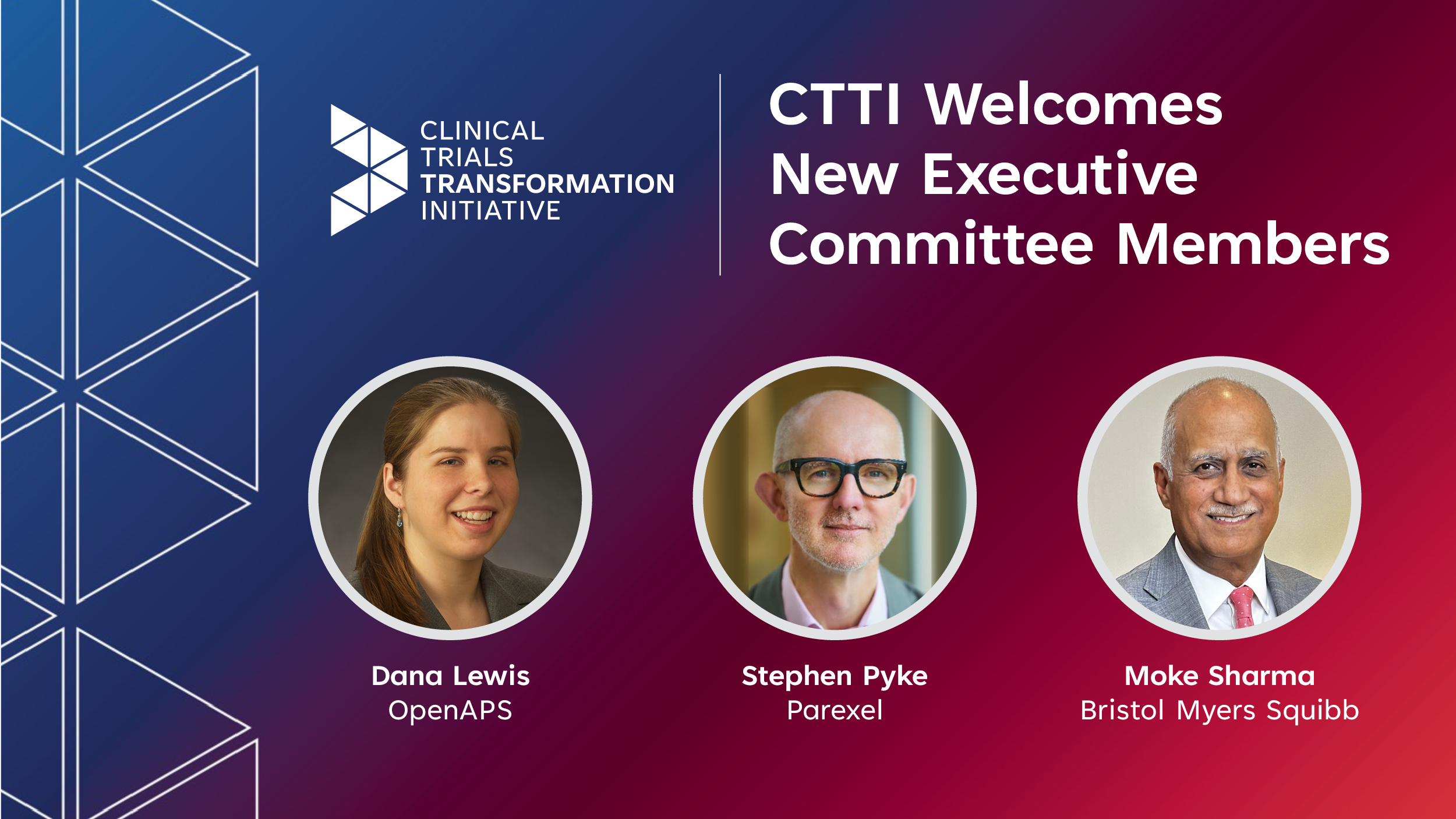
Today, CTTI announces the appointment of three new members to its Executive Committee, which is responsible for making recommendations about the overall direction and strategy for the organization. The new Executive Committee members, whose three-year term runs from 2025-2028, include:

  • Dana Lewis, OpenAPS
  • Stephen Pyke, Parexel
  • Moke Sharma, Bristol Myers Squibb

“CTTI is honored to welcome these three leaders to our Executive Committee,” said Morgan Hanger, CTTI Executive Director. “From their different seats as patient advocates, regulators, and research sponsors, all have truly unique expertise in leveraging innovation to generate and use the evidence that individuals need to make decisions, which is at the heart of our work.”

“The newly appointed Executive Committee members bring a wealth of experience as well as a demonstrated commitment to transformation,” said CTTI Executive Committee Chair Mark McClellan. “We look forward to collaborating with these leaders as they contribute their unique insights to our ongoing efforts to enhance and modernize clinical trials.”

The 19-member Executive Committee includes distinguished U.S. and international thought leaders in academia, government, industry, and patient advocacy who are experienced at envisioning and facilitating improvements in health care and medical research systems. Additionally, CTTI wishes to express sincere gratitude to the following outgoing Executive Committee members for their 20 years of collective service ranging from 2018-2024: Donna R. Cryer, Global Liver Institute; Pat Furlong, Parent Project Muscular Dystrophy; and Steven K. Galson, Boston Consulting Group.

Patient Engagement Collaborative Announces Eight New Members

CTTI News | December 11, 2024

Topics Included: Patient Engagement

Today, the U.S. Food and Drug Administration (FDA) and the Clinical Trials Transformation Initiative (CTTI) announced eight newly selected representatives for the Patient Engagement Collaborative (PEC). The group of 16 caregivers, patients, and patient group representatives meets with the FDA several times a year and discusses a variety of topics such as improving communications, education, and patient engagement related to medical product regulation. Those selected to the PEC are expected to serve for two years.

The eight new representatives are:

  • Bernard Coley
  • Lisa Craine
  • Rebecca Esparza
  • Syreen Goulmamine
  • Heather Guidone
  • Carter Hemion
  • Toni Jaudon
  • Mary Anne Meskis

The representatives were selected from 75 applications received in response to a Federal Register notice published in July 2024. These new members of the PEC include caregivers who have personal experience supporting someone with a health condition, patients who have personal disease experience, and representatives from patient groups who have direct or indirect disease experience. The selection committee, which included FDA staff from multiple centers, CTTI staff and several outgoing PEC members, worked to identify individuals with diverse perspectives and experiences who could meaningfully contribute and express the patient voice.

The PEC, a collaboration established by the FDA and CTTI in 2018, is a group of patient organizations and individual representatives who discuss ways to enhance patient engagement. The FDA and CTTI collaborate to involve representatives with a variety of perspectives including caregivers, patients, and representatives from diverse patient organizations and communities. The PEC is run by the FDA’s Public Engagement Staff, which is responsible for communicating, educating, and engaging with external partners including academia, caregivers, consumers, health care providers, patients, and trade associations on the agency’s policy priorities.

Going forward, the PEC will continue the dialogue around how patient perspectives can inform the clinical trials enterprise and provide information and resources to enhance PEC members’ knowledge about the FDA and CTTI activities to share with patient communities. Previous topics have included: increasing awareness of existing engagement mechanisms among patients and patient groups; increasing patients’ education to empower them to act as representatives of their broader community; enhancing communication between the FDA and patient communities; and promoting global collaboration of patient organizations.

The FDA and CTTI wish to thank the outgoing members for their service to the PEC over the past several years:

  • Kim Hindery
  • Yasmin Ibrahim
  • Seth Morgan
  • Cara O’Neill
  • Ceciel Rooker
  • Christina Sisti
  • Trina Stelly
  • Lauren Youngborg

Since 2008, CTTI has included patient advocates on its Executive Committee, Steering Committee, and project teams and, today, nearly all of its more than 30 sets of evidence-based recommendations and associated frameworks and tools mention inclusion of patients as a critical part of the clinical trials process.

Holiday Greetings from CTTI: Celebrating a Year of Progress

CTTI News | December 10, 2024

Topics Included:

As 2024 draws to a close, we reflect on a busy year of collaboration at the Clinical Trials Transformation Initiative (CTTI). Thanks to your shared commitment to advancing clinical research, we have developed critical new resources to assist with registration and reporting of clinical trials as well as assessing the ability to embed trial elements into clinical practice.

To showcase these achievements and more, we are thrilled to share our first-ever digital annual report, Modernizing Trials Together. This interactive report celebrates the resources we published in 2024 and highlights our collective impact on the clinical trials landscape.

At CTTI, we believe that actionable solutions underpin meaningful behavior change. That’s why in 2024 we focused on creating foundational tools and assessments like the Embedding Trials Feasibility Survey and the ClinicalTrials.gov report that empower stakeholders to improve processes.

Equally important, though, is our role as a connector in the clinical trials community. Through events like our new CTTI Dinners, panel discussions, public workshops, and Steering Committee meetings, we have fostered open dialogue among industry leaders, patients, regulatory agencies, and researchers. These gatherings are more than just opportunities to meet colleagues — they are the building blocks of future collaborations to make clinical research more impactful, inclusive and practical.

Looking to 2025, we are energized by the biological, computational, and technological advances that are redefining what’s possible in medical product development. CTTI will continue to anticipate the corresponding needs on the clinical development side — ensuring we have the tools for efficient, high quality clinical trials.

We wish you a joyful holiday season and a healthy, productive year ahead.